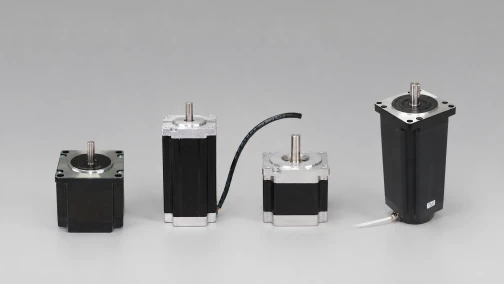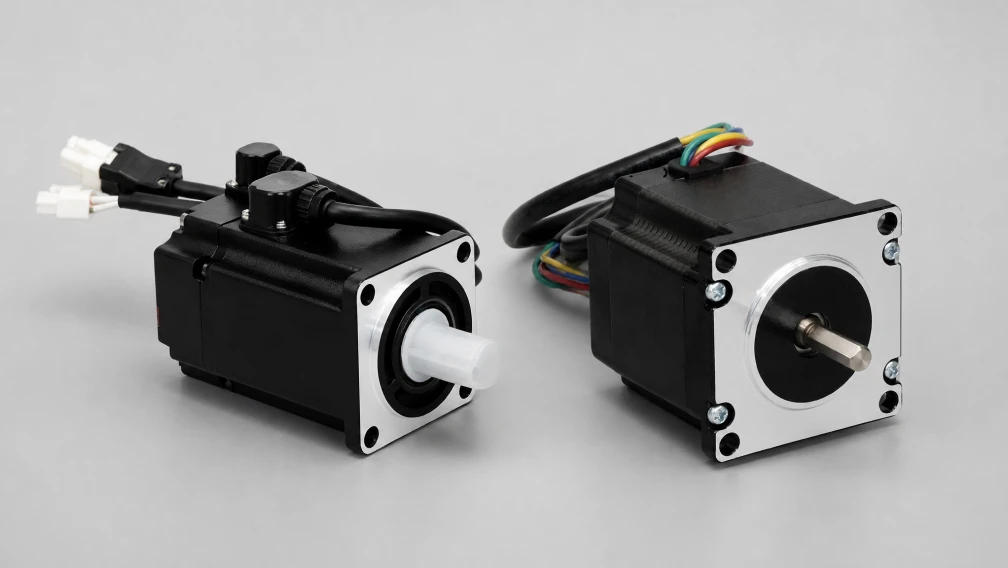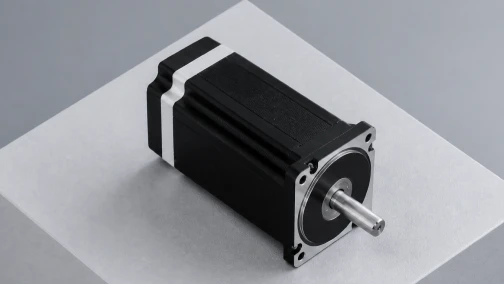

Two Motor Architectures, Two Engineering Philosophies
The stepper versus servo decision shapes the cost, performance ceiling, and maintenance profile of every motion axis on a machine. Both motor types position loads accurately, and both dominate different segments of industrial automation for sound engineering reasons. A stepper motor is an open-loop positioning device that moves in fixed angular increments and derives its accuracy from its mechanical construction. A servo motor is a closed-loop system that measures its own position continuously and corrects errors in real time. Neither is universally superior; each is the correct answer for a defined set of load, speed, and accuracy conditions.
This comparison examines the two technologies across the parameters that actually drive selection: internal design, control architecture, torque-speed behavior, accuracy and repeatability, efficiency, and total system cost. The goal is a defensible decision framework, not a specification-sheet summary.
1. Internal Design: Why Pole Count Decides Everything Else
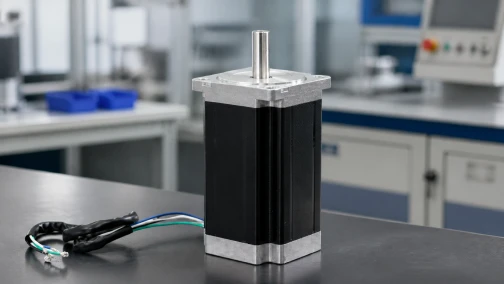
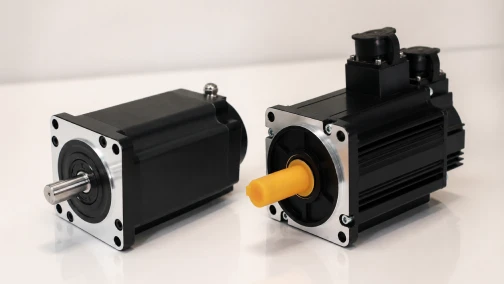
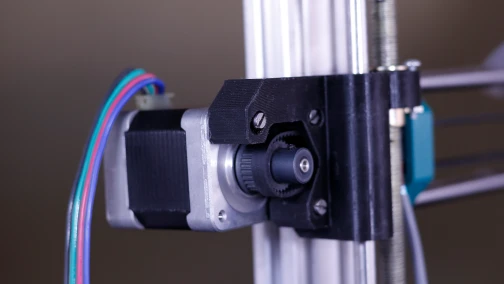
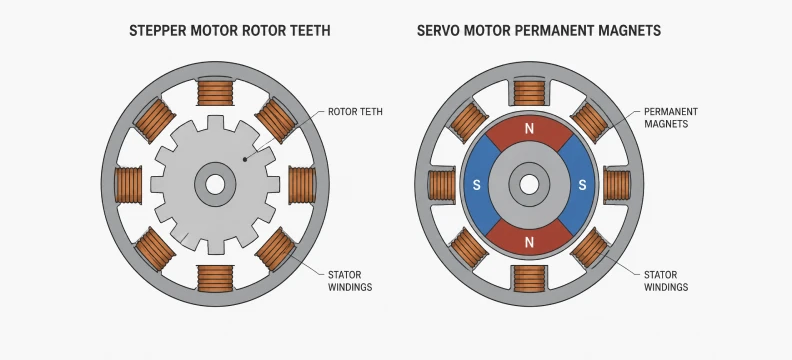
The performance gap between the two technologies originates in rotor and stator geometry. A hybrid stepper motor is a high-pole machine: two toothed rotor cups and a magnet produce 50 magnetic pole pairs, giving 200 full steps per revolution at 1.8° per step. This dense pole structure generates strong holding torque at zero speed and lets the rotor snap between stable magnetic detent positions without any sensor. The trade-off is that torque production depends on small angular displacements between rotor and stator fields, so available torque collapses as the step rate climbs.
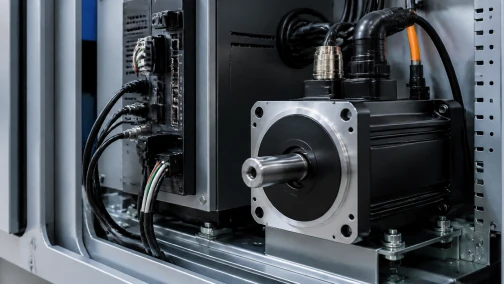
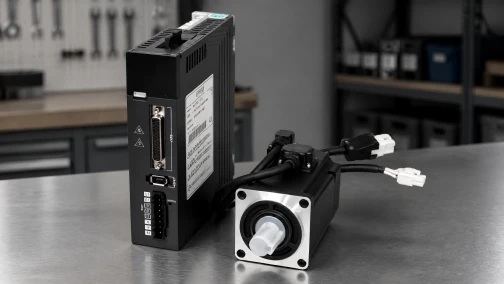
An AC servo motor uses a low-pole design, typically 4 to 8 permanent magnet poles, with a high-resolution encoder on the shaft. Fewer poles mean the motor cannot position itself magnetically; the drive must commutate electronically using encoder feedback. The payoff is a rotor with low inertia that accelerates hard and a torque profile that stays flat across the speed range. Pole count is the root cause behind nearly every row in the comparison tables that follow.
2. Control Architecture: Pulse Counting Versus Closed-Loop Correction
A stepper system counts pulses. The controller sends a pulse train to the driver, the driver advances the motor one increment per pulse, and position is inferred from the pulse count. The system is simple, deterministic, and cheap to commission. Its weakness is structural: if the load exceeds available torque, the rotor falls behind the commanded field and steps are lost silently. The controller continues counting pulses while the physical axis sits somewhere else. On a production machine, silent step loss means scrap parts discovered at inspection, or crashes discovered at the tool.
A servo system measures position. The encoder reports actual shaft position to the drive thousands of times per second, the drive compares it against the command, and current is adjusted to eliminate the difference. If the axis cannot follow, the drive raises a following-error alarm and stops the machine before damage accumulates. This architecture also enables torque-on-demand: the motor draws current proportional to the load instead of a fixed maximum, which is the root of the efficiency difference covered below.
3. Torque-Speed Behavior: Where Each Technology Runs Out
The torque-speed curve is the decisive document in this comparison. A stepper delivers its maximum torque at standstill and low speed, then loses torque steeply as speed rises. A typical NEMA 23 stepper on a modest supply voltage can lose half its rated torque by 500 RPM, and most hybrid steppers are effectively finished above 1,000 to 1,500 RPM. Inside the usable band, however, a stepper delivers more torque per frame size and per dollar than a servo.
A servo holds its continuous torque essentially flat from zero to rated speed, commonly 3,000 RPM, with peak torque of roughly three times continuous available for acceleration bursts. Above rated speed, torque falls into a constant-power region, but useful output extends well past 4,000 RPM. Any axis that must sustain torque at speed, accelerate aggressively, or run above 1,500 RPM is servo territory by physics, regardless of budget preferences.
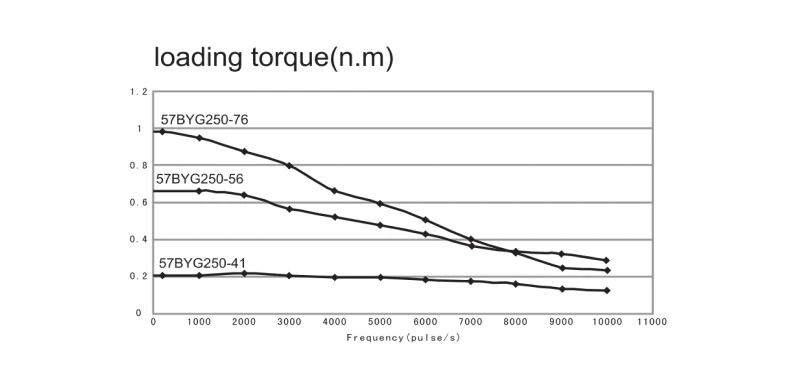
4. Accuracy, Resolution, and Repeatability: Three Different Numbers
Spec sheets confuse these terms, so the distinctions matter. Stepper full-step accuracy is typically ±3 to 5% of one step, and critically, the error is non-cumulative: it does not grow over revolutions. Microstepping raises command resolution dramatically, but microstep positions are not linearly accurate, and real-world accuracy is further limited by load torque deflecting the rotor within its magnetic detent zone. A stepper is highly repeatable at light, stable loads, which is why it dominates 3D printers and scanners.
Servo accuracy is set by encoder resolution and loop tuning. A 17-bit encoder divides one revolution into over 130,000 counts, and 23-bit devices exceed 8 million. More importantly, the loop actively corrects against disturbances, so the servo holds its accuracy under cutting forces, friction changes, and inertia variation, exactly the conditions where stepper accuracy degrades. One counterpoint deserves mention: at standstill, a stepper locks rigidly into a fixed deadband with zero motion, while a servo holds position by continuous correction and can exhibit microscopic hunting on compliant mechanics. For dispensing, optical staging, and inspection axes, that rigid standstill behavior is a genuine stepper advantage.
5. Efficiency, Heat, and Idle Behavior
A stepper draws near-rated current whenever it is energized, including at standstill, because holding torque requires current. The motor runs warm at idle and hot under continuous duty, and most of that input power becomes heat rather than motion. Over a multi-year duty cycle on a continuously running machine, the energy cost of a stepper axis can exceed its purchase price.
A servo draws current in proportion to the work being done. Idle current is minimal, and heat generation tracks the actual load. For single axes on intermittent duty this difference is academic; for a ten-axis machine running two shifts, it shows up in the utility bill and in cabinet cooling requirements.
6. System Cost and Total Cost of Ownership
Purchase price favors the stepper clearly. Motor plus driver typically runs 20 to 30% below an equivalent servo package, wiring is simpler, and commissioning requires no loop tuning. Hidden costs alter the picture at scale: servo drives report diagnostic data that shortens troubleshooting, detect jams before mechanical damage occurs, and eliminate the scrap produced by silent step loss. The honest accounting is application-specific. A cost-sensitive axis with a stable, predictable load never justifies a servo premium; a production axis where one undetected stall ruins a batch pays for closed-loop feedback quickly.
7. Side-by-Side Technical Comparison
| Parameter | Stepper Motor | Servo Motor |
| Control method | Open-loop pulse counting | Closed-loop with encoder feedback |
| Pole count | 50 pole pairs (200 steps/rev) | 4–8 poles |
| Torque profile | Maximum at low speed, decays steeply | Flat to rated speed, 3× peak for bursts |
| Practical speed range | 0–1,500 RPM | 0–5,000+ RPM |
| Position error detection | None; steps can be lost silently | Real-time correction and alarms |
| Standstill behavior | Rigid holding torque, some idle heat | Active correction, possible hunting on soft mechanics |
| Current draw | Near-rated whenever energized | Proportional to load |
| Commissioning | Plug-and-play | Loop tuning required |
| System cost | Baseline | 20–30% premium, higher with high-resolution feedback |
8. The Decision Framework
Choose a stepper when the load is stable and predictable, operating speed stays below roughly 1,000 RPM, the axis benefits from rigid holding torque, and budget or commissioning simplicity drives the specification. 3D printers, entry-level CNC routers, scanners, and labeling machines live here. Our stepper motor sizing guide covers the calculation workflow.
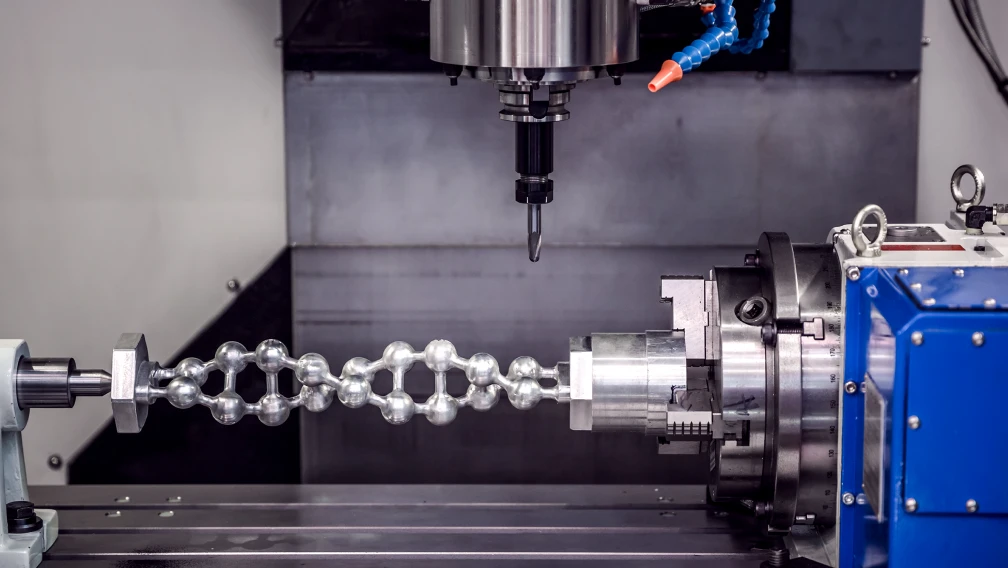
Choose a servo when loads vary, speed exceeds 1,500 RPM, acceleration is aggressive, position must be verified rather than assumed, or the axis cannot tolerate an undetected stall. Robotics, high-speed packaging, machining centers, and synchronized multi-axis equipment live here.
Consider the middle path. A closed-loop stepper motor pairs stepper construction with encoder feedback, adding stall detection and position correction while keeping stepper simplicity, low-speed torque density, and cost structure. For axes that outgrow open-loop reliability requirements but cannot justify full servo cost, it closes most of the gap. Resonance and noise behavior across all three architectures is covered in our noise and vibration guide.
Get an Unbiased Recommendation for Your Axis
We manufacture both technologies, so our engineers have no preference to sell you. Send your load data, motion profile, and duty cycle, and we will return a sized recommendation for the architecture that fits, typically within 24 hours. Datasheets and CAD models for both product lines are in our download center. Contact our engineering team to discuss your application.
Frequently Asked Questions (FAQ)
Question: Is a servo motor more accurate than a stepper motor?
Answer: Under real working conditions, yes. A servo verifies its position with encoder feedback and corrects disturbances in real time, so its accuracy holds under varying loads and at high speed. A stepper's accuracy is excellent at light, stable loads and low speeds, but it degrades silently if the rotor loses steps or deflects under load. For repeatability at rest, the two are comparable; for verified accuracy in production conditions, the servo wins.
Question: Can a stepper motor replace a servo motor to save cost?
Answer: Only when the application stays inside the stepper's physical envelope: stable loads, speeds below roughly 1,000 RPM, no aggressive acceleration, and tolerance for undetected position errors. Outside those limits the substitution fails in predictable ways, including stalls, lost steps, and scrap. A closed-loop stepper is the safer cost-saving substitution, since it adds stall detection and error correction at a price between the two technologies.
Question: Why does a stepper motor get hot even when it is not moving?
Answer: Holding a position requires current. A stepper generates holding torque by energizing its windings at or near rated current, so the motor dissipates power as heat whenever it is energized, including at standstill. Many drives offer automatic idle current reduction, which cuts the current by half or more when the motor is stationary and reduces heat significantly without sacrificing position.
Question: Which motor type is better for a CNC machine?
Answer: It depends on the machine class. Entry-level routers and plasma tables with predictable cutting loads run reliably on open-loop or closed-loop steppers, and most desktop machines use them. Production machining centers with high rapid-traverse speeds, heavy cutting forces, and multi-axis interpolation use servos, because torque at speed and verified position under load are requirements rather than preferences.
Question: What is the maximum practical speed for a stepper motor?
Answer: Most hybrid steppers deliver useful torque up to 1,000 to 1,500 RPM, with the exact ceiling set by winding inductance, supply voltage, and load. Torque decays steeply through that range, so a motor that holds 3 N·m at standstill may deliver under 1 N·m at its top speed. Servos hold rated torque to 3,000 RPM and run past 4,000 to 5,000 RPM in the constant-power region, which is why high-speed axes are servo applications.
Question: Does a closed-loop stepper eliminate the gap between steppers and servos?
Answer: It eliminates the most dangerous part of the gap: silent position loss. Encoder feedback gives the closed-loop stepper stall detection, position verification, and error correction. What it does not change is the underlying high-pole motor physics, so torque still decays with speed and the practical ceiling stays near 1,000 to 1,500 RPM. For axes inside that envelope, it is often the most cost-effective architecture available.
Question: Which motor consumes more power over a year of operation?
Answer: The stepper, by a wide margin, on any axis with significant idle or partial-load time. A stepper draws near-rated current whenever energized, while a servo draws current proportional to the actual load. On continuously running multi-axis machines, the stepper's energy cost over several years can exceed its purchase price, which is why total cost of ownership should accompany purchase price in any serious comparison.
-

Cymotorix
Stepper Motor & Servo Motor Manufacture
Cymotorix is a China-based motor manufacturer with 20+ years of experience producing hybrid stepper motors, AC servo motors, and matched drivers for OEM customers worldwide.