
The Mechanical Necessity of Gear Reduction
Directly coupling a mechanical load to a motor shaft is optimal for simplicity, but it is frequently mathematically impossible in heavy industrial applications. When an automation axis commands a massive payload, the required acceleration torque and the reflected mechanical inertia often exceed the physical capabilities of standard motor frames. To bridge this gap, engineers introduce mechanical advantage through gear reduction. Among the available transmission technologies, the planetary gearbox has become the default standard for precision motion control.
Planetary gearheads offer a unique combination of high torque density, inline coaxial mounting, and low torsional backlash. They allow compact servo motors to maneuver heavy payloads that would otherwise require massive, cost-prohibitive direct-drive platforms. This technical manual details the internal kinematics of planetary gearboxes, the physics of inertia matching, the impact of mechanical backlash on positional accuracy, and the engineering formulas required to specify a gearbox for industrial actuation.
1. Planetary Architecture and Torque Distribution
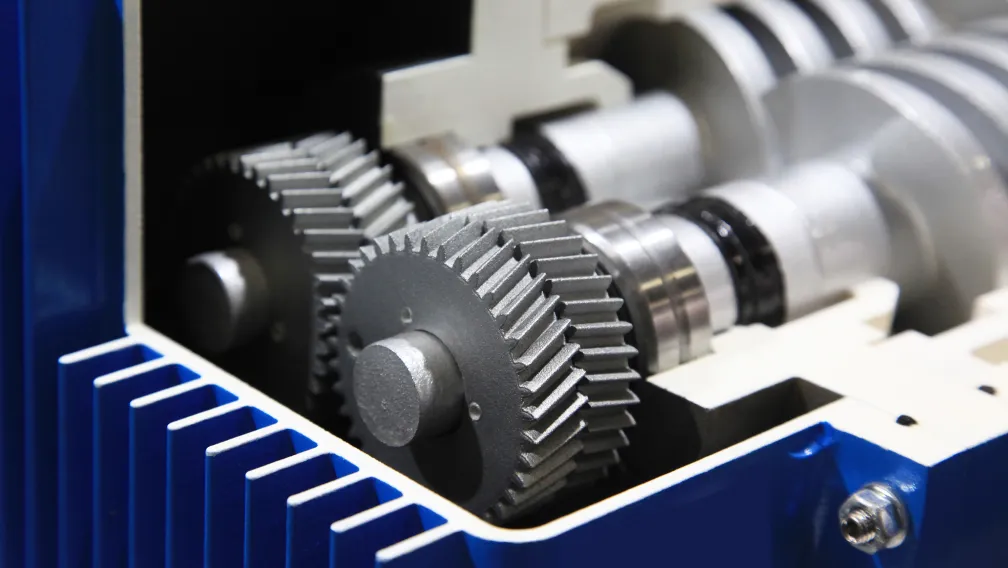
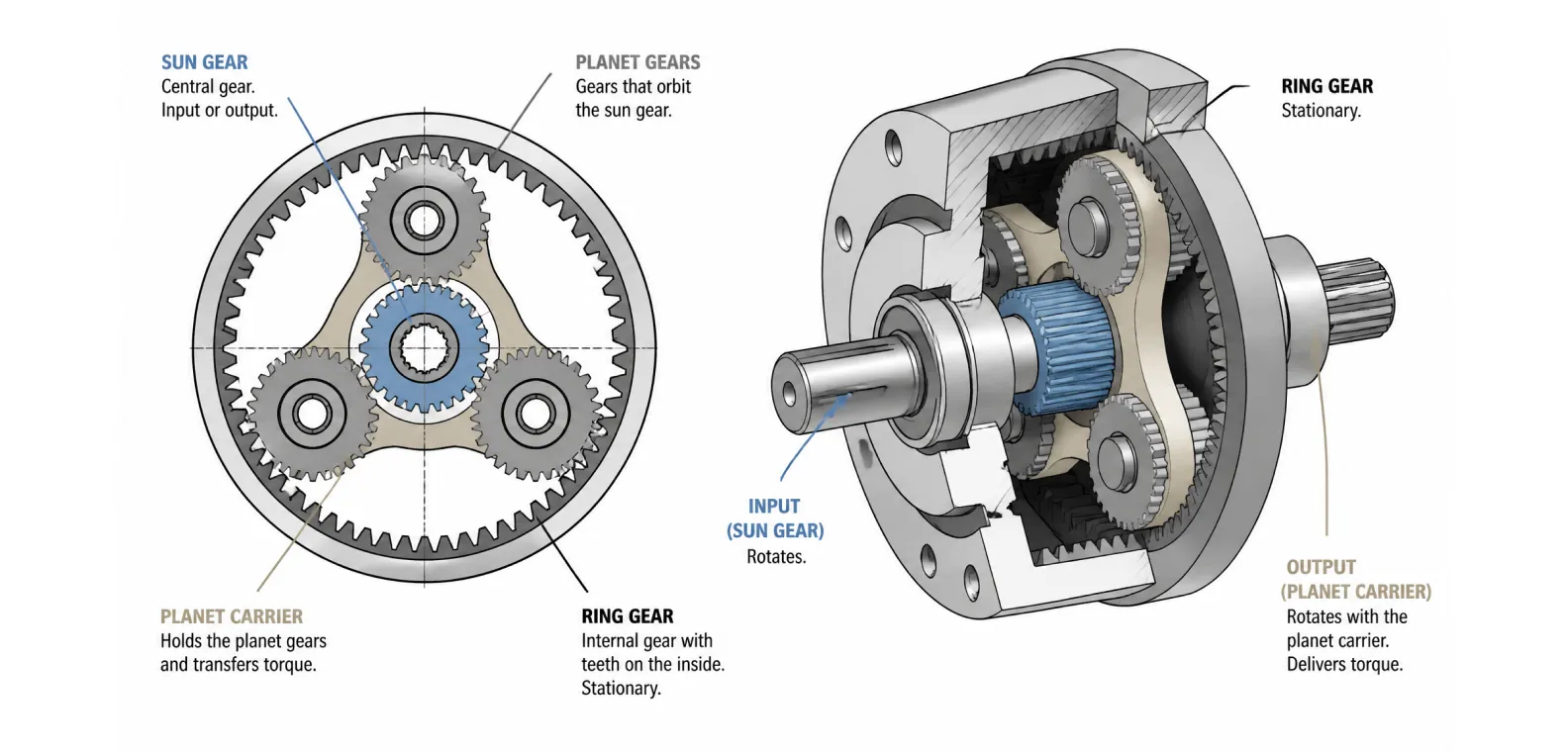
The term "planetary" refers to the internal kinematic arrangement of the gearhead. A central "sun" gear, directly attached to the motor's input shaft, drives multiple "planet" gears. These planet gears are mounted on a carrier and orbit the sun gear while meshing with a stationary outer "ring" gear integrated into the gearbox housing. As the planet gears orbit, they rotate the carrier, which is connected directly to the output shaft.
This specific geometry distributes the mechanical load across three or four planetary gear meshes simultaneously, rather than a single point of contact found in traditional parallel-axis spur gears. This distributed load path provides exceptional torsional stiffness and allows the gearbox to transmit massive torque loads within a highly compact radial footprint. Furthermore, the inline design ensures the output shaft remains perfectly concentric with the motor shaft, simplifying machine frame design and allowing for straightforward flange mounting.
2. The Physics of Inertia Matching (The 1/i² Rule)
While gearboxes are primarily viewed as torque multipliers, their most critical function in closed-loop motion control is inertia reduction. Stepper and servo systems operate as tuned mass-spring loops. If the inertia of the physical load (the mass being moved) is significantly larger than the internal inertia of the motor's rotor, the control loop becomes unstable. This mismatch manifests as violent mechanical resonance in stepper motors and aggressive positional hunting in servo systems.
A planetary gearbox reduces the load inertia reflected back to the motor by the square of the gear ratio (i²). The formula for reflected inertia is: J_reflected = J_load / i².
If an automated turntable possesses a load inertia of 100 kg·cm², and it is directly driven by a motor with a rotor inertia of 1 kg·cm², the inertia mismatch is 100:1. This axis will stall or oscillate uncontrollably. By installing a 10:1 planetary gearbox, the reflected inertia drops to 100 / (10²) = 1 kg·cm². The motor now sees an ideal 1:1 inertia match, resulting in flawless acceleration, rigid standstill holding, and zero resonance, despite the physical mass of the turntable remaining unchanged.
3. Calculating Output Torque and Speed Limits
Selecting a gearbox requires validating both the torque multiplication and the thermal speed limits of the planetary stages. The output torque of the gearbox is the product of the motor's input torque, the gear ratio (i), and the mechanical efficiency of the gear mesh (η).
Output Torque = Input Torque × i × η
Single-stage planetary gearboxes (typically offering ratios from 3:1 to 10:1) operate with efficiencies around 95% to 97%. To achieve higher ratios (15:1 up to 100:1), manufacturers stack a second planetary stage inside the housing. Two-stage gearboxes experience higher mechanical friction, dropping the efficiency to approximately 85% to 90%. Engineers must factor this efficiency loss into their sizing calculations to prevent torque starvation at the output shaft.
Additionally, input speed is a severe constraint when pairing gearboxes with AC servo systems. While closed-loop steppers rarely exceed 1,000 RPM, modern servos easily sustain 3,000 to 5,000 RPM. Forcing a planetary gearbox to accept a 5,000 RPM input generates immense friction and heat at the sun gear mesh. If the input speed exceeds the gearbox's thermal rating, the internal synthetic grease will break down, leading to rapid catastrophic failure of the planetary needle bearings.
4. Understanding Backlash and Arc-Minutes
In reversing motion applications, the mechanical clearance between the gear teeth becomes a critical error factor. This clearance, known as backlash, is the amount the output shaft can rotate while the input shaft remains locked. Backlash is measured in arc-minutes, where one arc-minute equals 1/60th of a single degree.
Standard industrial planetary gearboxes typically exhibit 12 to 15 arc-minutes of backlash. High-precision "low-backlash" variants reduce this clearance to 3 to 5 arc-minutes by utilizing tighter machining tolerances and helical gear cuts instead of straight spur cuts. To understand the physical impact at the tool tip, engineers calculate the linear error based on the final transmission element.
If a gearbox with 10 arc-minutes of backlash drives a pulley with a 100mm radius, the linear deadband at the belt is: (10 / 60) × (π / 180) × 100mm = 0.29mm. Whenever the motor reverses direction, the controller must rotate through this 0.29mm deadband before the belt physically begins moving the opposite way. For highly precise CNC contouring or robotic dispensing, selecting a precision 3 arc-minute gearbox is mandatory to maintain surface finish tolerances.
5. Radial and Axial Shaft Loading Capacities
Beyond torque multiplication, gearboxes serve as structural isolation barriers protecting the motor. Standard stepper and servo motors utilize relatively small internal ball bearings designed primarily for rotational speeds, not heavy side loads. Direct-driving a highly tensioned timing belt places massive radial force directly on the motor shaft, causing premature bearing failure and shaft deflection.
Planetary gearboxes are constructed with heavy-duty output bearings—often oversized deep-groove ball bearings or tapered roller bearings. These bearings are explicitly engineered to handle extreme radial loads (forces perpendicular to the shaft) and axial loads (forces pushing into or pulling out of the shaft). Integrating a gearbox transfers the destructive mechanical side loads away from the delicate motor bearings and onto the rugged accessories housing, extending the operational lifespan of the entire actuation node.
6. Engineering Selection Criteria for Geared Axes
Question: How do automation engineers decide between specifying a massive direct-drive motor or a smaller motor paired with a planetary gearbox?
Answer: Engineers execute a strict cost-to-performance calculation based on inertia and footprint. If the load-to-rotor inertia ratio exceeds 10:1, or if the spatial footprint of the machine cannot accommodate a NEMA 34 or 130mm servo frame, a gearbox is mathematically required. The engineer selects a smaller motor (e.g., NEMA 23 or 60mm servo) and applies a gear ratio that simultaneously reduces the reflected inertia below 5:1 and multiplies the continuous torque to meet the load demand. This geared solution is almost always lighter, smaller, and more cost-effective than an oversized direct-drive installation.
7. Lubrication, Maintenance, and Environmental Sealing
Modern planetary gearboxes intended for motion control are designed as "lubricated for life" components. They are sealed at the factory with high-performance synthetic grease capable of withstanding extreme pressure (EP) shear forces. Unlike heavy industrial gear reducers that require periodic oil baths and fluid changes, servo-rated planetary gearboxes require zero scheduled maintenance.
For applications in the food, beverage, or pharmaceutical sectors, gearboxes must endure high-pressure chemical washdowns. Standard aluminum housings will corrode under these conditions. Engineers must specify washdown-rated gearboxes featuring 304 or 316 stainless steel housings, IP69K-rated dual-lip Viton shaft seals, and food-grade NSF H1 compliant lubrication. Ensuring the gearbox matches the environmental ingress protection (IP) rating of the attached closed loop stepper motor prevents fluid ingress from destroying the internal planetary carrier.
Custom Gear Integration and Automation Support
Calculating reflected inertia, mechanical backlash propagation, and thermal input limits is the foundation of reliable machine design. Cymotorix supplies a complete ecosystem of motion components, perfectly matching our high-torque motors with precision planetary gearheads. Our engineering team assists OEMs in executing dynamic sizing calculations, ensuring the gear ratio, backlash rating, and bearing capacities align with the exact demands of your payload. We provide pre-assembled, factory-tested geared motor units ready for immediate bolt-on installation. Contact our technical engineering department to review your mechanical specifications and optimize your motion transmission architecture.
Frequently Asked Questions (FAQ)
Question: What is the mathematical advantage of using a planetary gearbox for inertia matching?
Answer: A planetary gearbox reduces the load inertia reflected to the motor by the square of the gear ratio. For example, installing a 5:1 gearbox reduces the load inertia the motor actually "feels" by a factor of 25 (5 squared). This instantly stabilizes oscillating systems, eliminates stepper motor resonance, and allows for extremely aggressive acceleration profiles.
Question: Why do planetary gearboxes generate heat when paired with AC servo motors?
Answer: AC servo motors often operate at speeds between 3,000 and 5,000 RPM. This high input velocity causes the sun gear and planetary gears to rotate at extreme speeds, generating immense friction and churning the internal synthetic grease. If the motor's continuous speed exceeds the gearbox's thermal input rating, the heat cannot dissipate, leading to seal failure and bearing destruction.
Question: What is the difference between a single-stage and a two-stage planetary gearbox?
Answer: A single-stage gearbox contains one set of planetary gears and typically offers reduction ratios between 3:1 and 10:1 with approximately 95% efficiency. A two-stage gearbox stacks a second set of planetary gears sequentially inside a longer housing to achieve ratios from 15:1 to 100:1. The two-stage design has higher internal friction, reducing total efficiency to around 85%.
Question: How does mechanical backlash in a gearbox affect CNC machining accuracy?
Answer: Backlash creates a deadband whenever the axis reverses direction. If a gearbox has 15 arc-minutes of backlash, the motor must rotate a specific amount before the output shaft begins turning in the new direction. In CNC interpolation, this delay causes flat spots on circular cuts and dimensional inaccuracies on machined parts. High-precision machines require low-backlash gearboxes (under 5 arc-minutes) to prevent this error.
Question: Can I mount a heavy timing belt pulley directly to the output shaft of a planetary gearbox?
Answer: Yes. Unlike standard stepper or servo motors, planetary gearboxes are built with heavy-duty output bearings designed specifically to handle high radial loads. Mounting a highly tensioned timing belt pulley directly to the gearbox output shaft is standard industrial practice and will not cause shaft deflection or bearing failure.
Question: Do industrial planetary gearboxes require regular grease replacement?
Answer: No. Precision planetary gearboxes for stepper and servo applications are sealed and lubricated for life with high-performance synthetic grease at the factory. They require zero preventative maintenance or fluid top-offs throughout their designed operational lifespan (typically 20,000+ hours), provided they are operated within their rated thermal and torque limits.
-

Cymotorix
Stepper Motor & Servo Motor Manufacture
Cymotorix is a China-based motor manufacturer with 20+ years of experience producing hybrid stepper motors, AC servo motors, and matched drivers for OEM customers worldwide.